From Between the Lines and Blueprints, Chapter 1: The Pink Slip
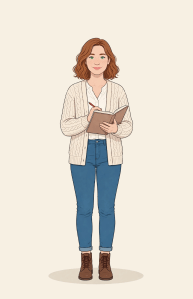
The gray cotton of my favorite oversized sweater was thinning at the elbows, worn down by three full years of sitting at our quartz kitchen island, meticulously formatting monthly accounting spreadsheets that nobody ever read and corporate executives probably never even opened.
Working a remote administrative job for a mid-sized accounting firm meant my world was neatly, defensively contained within four pale gray walls. It was safe. It was predictable. And it was light-years away from the dusty, ink-stained literary world of publishing I had dreamed of back in college, when I still believed stories mattered more than bottom-line debits and credits. I had spent countless late nights in the university library surrounded by stacks of classic paperbacks, convinced my future would involve margin notes, manuscript evaluations, and fighting for authors whose voices deserved to be heard. Instead, life had handed me macro-enabled pivot tables, multi-column expense reconciliations, and quarterly tax summaries.
Whenever the weight of that quiet compromise pressed too hard against my chest, my thumb would automatically drift downward, tracing the faint, silvery line of the surgical scar on my left abdomen right through the soft knit of my sweater. It was my private, tactile barometer—a ridge of altered tissue that divided my life into a strict, unyielding before and after.
Before, I used to say yes to everything. I stayed out until dawn in drafty campus coffee shops, ignored deadlines until the thrill of the chase forced a burst of midnight inspiration, and believed that uncertainty was just part of the adventure of being twenty-three. Then came the night the dull ache in my right side bloomed into a blinding, white-hot agony that dropped me to my linoleum kitchen floor. I remember the sterile glare of the emergency room fluorescent lights, the frantic shouting of nurses, the cold sweep of antiseptic, and waking up hours later with a stomach sliced open and an appendix that had quietly, traitorously turned to rot inside me.
The physical recovery had taken months, but the psychological aftermath had become permanent. That scar was a permanent, jagged reminder that our bodies are fragile, porous things, completely at the mercy of internal betrayals and external chaos. It taught me, with terrifying finality, that safety is an illusion.
Keeping my pulse firmly under control, avoiding surprises, and managing every variable in sight had been my full-time job ever since. I’d spent my entire adult life building intricate psychological scaffolding around my anxiety. If I planned my meals a week in advance, color-coded my notebooks by project urgency, kept the apartment thermostat locked at precisely seventy degrees, and never, under any circumstances, raised my voice or rocked the boat, the chaotic unpredictability of the world would leave me alone. It was a fragile, hyper-managed sort of peace, but it was mine, and I guarded it like a dragon with a hoard of gold.

Around me, my apartment was a sanctuary of those controlled variables. The late-afternoon sunlight filtered softly through the sheer linen curtains, casting pale, geometric lattice patterns across the hardwood floors. A mug of Earl Grey was cooling on a cork coaster right beside my laptop to the exact temperature where I liked it, steeped for precisely four minutes in boiling water, infused with a splash of creamy oat milk, and finished with a single, measured pump of sweet lavender syrup. A stack of pristine, color-coded notebooks sat neatly beside it, waiting for tasks that now no longer existed.
Every corner of the living space reflected my desperate need for order. The throw pillows on the velvet sofa were arranged at precise forty-five-degree angles. The shoe rack by the entryway aligned our footwear by height and frequency of wear. Even the pantry shelves were organized alphabetically, ensuring no stray spice jar or box of pasta could ever disrupt my domestic equilibrium. To an outside observer, it might have looked immaculate, even peaceful. To me, it was a fortress wall built brick by brick to keep out the unpredictable terror of a universe that had once nearly cost me my life.
For the last four years, safety had been a well-rehearsed routine. I knew how to draw strictly inside the lines. I knew how to blend into the background so thoroughly that even the universe might forget I was there.
Then the calendar notification chimed softly on my screen.
A small, innocent-looking red banner flashed across the top of my display, announcing an unscheduled 3:00 PM “Alignment Chat” with Human Resources.
Want to keep reading? Maeve’s story is waiting for you, and I’d love for you to come along for the rest of it.

